

Unspoken
Disciplines
Urban Design
Tech & Digital Media
Heritage Studies
Place Branding
Experience Design
Collaborators
Hyper Island Digital School
Karlskrona Municipality
Blekinge Institute of Technology
Location
Karlskrona, Sweden
Status
Independent & Collaborative Research Project & Proposal

south of Sweden
Karlskrona
At first, a gather of islands with scattered occupants making their living through farming and fishing, few would guess at the time that this will be Sweden's core strategic location for its royal military navy.
Karlskrona was founded in 1680 as a naval city and has since been Sweden's most important naval base. The city developed rapidly, mainly due to its shipyard, Sweden's largest industrial employer in 1711, having 1,100 workers. Dreams were high, up to the level of taking the place of Stockholm and becoming the capital, but history had other plans.
The city lost much of its glory and stagnation occurred due to war and plagues. Between 1701 and 1711, about 7,000 people died when the plague struck the city, and in 1741 and 1789, the city was again hit by plagues, each claiming 6,000 lives.
Today, the architecture in Karlskrona is an outstanding example of 17th and 18th-century urban planning, with wide streets, baroque grand buildings, and a distinct maritime character. The combination of history, architecture and military imprint makes Karlskrona unique and has been, since 1998, a UNESCO World Heritage site.
Karlskrona
Archipelago

Trossö


Stora
Torget
Trossö
main island of Karlskrona
Napoleon, he understood the grammar of gunpowder
Cardinal Newman, aka John Henry Newman

Hogland's Park
Clock
Tower
Stora
Torget
Amiral's Park
A long,
long time ago..
..more precise in 1870, a comprehensive modernisation of the naval shipyard in Karlskrona began. The restructuring of a shipyard was necessary to be able to build ships of the new era. The transition from sails and wood to steam and armoured plate and vessels also meant the introduction of a new technology and mechanisation with new workshops and machinery.
To facilitate transport between the many different workshops and buildings within the extensive shipyard area, these were gradually connected to each other with a system of narrow-gauge railway tracks that were successively expanded.
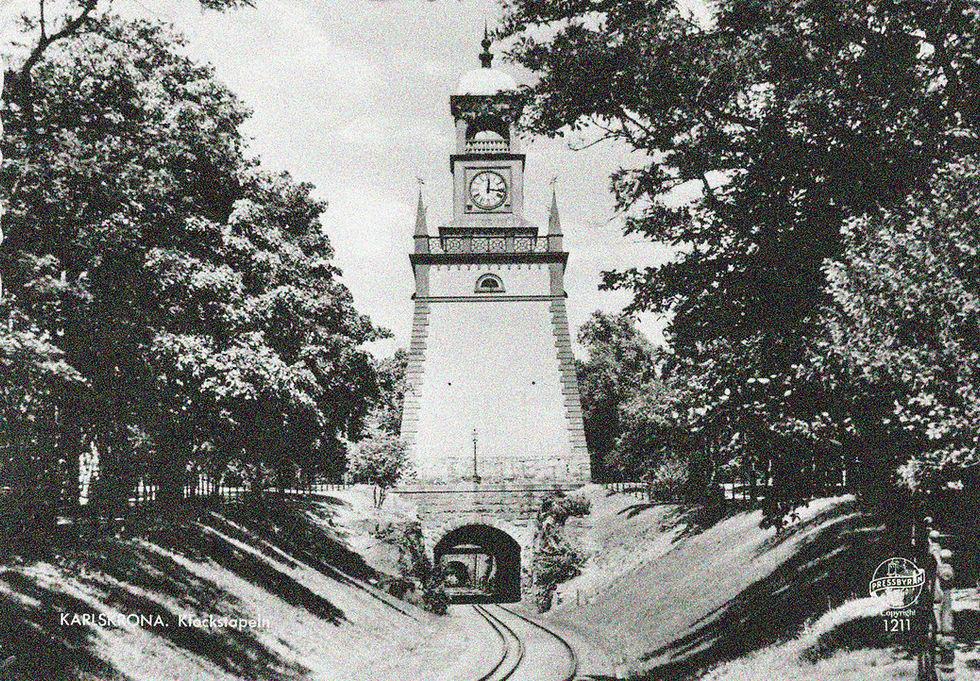
For smooth connectivity and transport, the City Council, decided in 1884 to begin the building of a tunnel for a section of this railway system under the main square of the city - Stora Torget. For a long time, the railway tunnel was an important route for freight transport to the shipyard, but was also occasionally used for passenger traffic with workers' trains.
During World War I and World War II, the railway tunnel took on a new function - a large underground facility was gradually built out with rock caverns and tunnels under Stora Torget, systems for communication, control and protection were housed in connection with the railway tunnel.The tunnel was last used in 1990, and since 2013, the ownership shifted from the Swedish Fortifications Agency to Karlskrona Municipality.
In 2016, the Municipality decided to make use of such a unique structure and gathered an interdisciplinary team, including experts in conservation, tourism, urban designers, artists, joined by the city's top university and independent media school to find together the best solution and function in a hip, contemporary fashion.
Please find bellow the result,
but first some nostalgia pictures:


Sketch Plan
underground connections to the tunnel
The lowest hanging fruit of an intense week of collaboration, exchange and cross-disciplinary design is a cross-boarder proposal between urban design and digital media, a playful interpretation of the history of Karlskrona and a revamping of an old industrial/military hidden structure into a physical and digital portal. The design area was limited to the tunnel and, due to structural and safety reasons, the side caverns as well as a more detailed proposal for the Clock Tower were left for a future stage.
The Tunnel
The main public square of Karlskrona, Stora Torget, hides bellow a tunnel with a narrow old school rail line, which the Municipality wishes to make good use for both its citizens and visitors arriving particularly in the summer. The result: The Tunnel transforms into one long Gate into the City's history, culture and life - interactive, informative and peak ending.
The old school rail lines happen to begin long before the tunnel and that is where it all begins - near Hogland's Park. For 290m out into the urban, 265m inside the tunnel and 170m in an open green couloir, the rail lines take various shapes as you can see bellow and, through an application on the phone, one can remotely slide along the wooden boards, creating variations of sitting benches. Since it is a protected heritage, the Tunnel can be accessed via the Tourist's Bureau just by its entrance, where you will be borrowed an Augmented Reality Device that will seriously trip you in the past, future and the imaginary.The experience peaks when reaching at the end the Clock Tower, another architectural jewel and heritage where digital designers plan to lift your spirit through an outer-time indoor experience, after which you are good to go and discover further the real city.


Clock Tower
Hogland's Park
Tourist's Bureau
Entrance Tunnel
Rails in Green Couloir
Amiral's Park
Exit Tunnel
Rails in Tunnel
very smart
Smart Rails

